

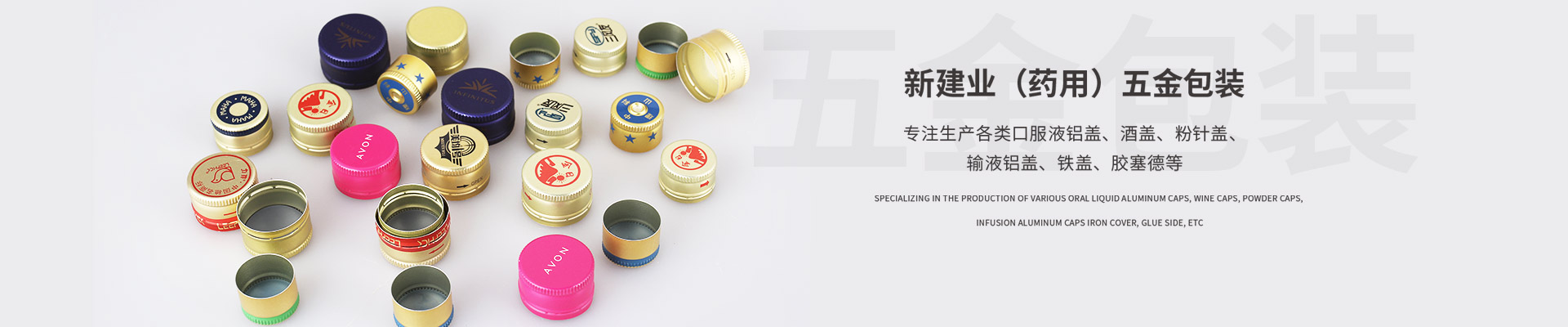
Aluminum anti-theft caps are made of high-quality special aluminum alloy materials, which are mainly used for the packaging of alcohol, beverages (including steam and non-steam) and medical and health products, and can meet the special requirements of high temperature cooking and sterilization. Aluminum bottle caps are mostly processed on a production line with a relatively high degree of automation, so the requirements for the strength, elongation and dimensional deviation of the material are very strict, otherwise it will produce cracks or creases during processing. In order to ensure that the bottle cap is easy to print after forming, the bottle cap material is required to have a flat surface, no roll marks, scratches and stains. The generally used alloy state is 8011-H14, 3003-H16, etc. The material specifications are generally 0.20mm thick ~ 0.23mm, width 449mm ~ 796mm. The production of aluminum bottle cap material can be made by hot rolling or continuous casting and continuous rolling, and then cold rolled. At present, the production plant of our country's defense capping material uses continuous casting and rolling billets, which is superior to casting and rolling billets.
Dongfang.com News on September 17: According to industry insiders, China's national defense stolen caps will grow at a rate of 10% per year. In 2010, about 15 billion anti-theft caps will be needed, and aluminum plate and strip materials will be 53,500 to 60,000 tons. . The demand for aluminum caps is growing rapidly. At present, most of the packaging of liquor, wine, medicinal wine and beverages in China is still dominated by broken glass bottles, and many of the caps are made of aluminum. At present, there are tens of thousands of various alcohol production plants in China. Evaluation Survey Editor
According to information, the annual output of liquor in recent years has been around 8 million tons, of which about 50% of the wine bottles use anti-theft caps.
Alcohol anti-counterfeiting is more and more valued by manufacturers. As part of packaging, wine bottle caps have been developed towards diversified and high-end anti-counterfeiting functions and production forms. Bottle caps are widely used by manufacturers. Although the function of anti-counterfeit bottle caps is constantly changing, there are two main types of materials used, namely aluminum and plastic. Internationally, most wine packaging caps use aluminum caps, which are characterized by simple appearance, fine production, and advanced printing technology to make them consistent in color and beautiful in pattern. Compared with plastic bottle caps, aluminum bottle caps not only have good performance, but also have low cost, no pollution, and can be recycled.
The plastic anti-counterfeit cover has a complex structure and has an anti-backflow function. The surface treatment process methods are diverse, the three-dimensional sense is strong, the appearance is unique and novel, but the inherent defects cannot be ignored. Since the glass bottle adopts a thermoforming process, the size error of the bottle mouth is large, and it is difficult to achieve a high degree of sealing. Relevant packaging experts pointed out that due to the strong static electricity, plastic bottle caps are easy to absorb dust in the air, and the debris generated by ultrasonic welding is difficult to eliminate. The problem of plastic debris on wine pollution has not been completely resolved Method. In addition, in order to reduce costs, some manufacturers of plastic bottle caps dope into the raw materials, and the hygiene situation is worrying. Because the caps are partly connected to the glass bottle mouth, it is not easy to recycle. Environmental experts believe that it is natural Environmental pollution is obvious. In addition, plastic bottle caps cost about one-fold or more than aluminum bottle caps.